By Christian Thibaudeau
The gym was busy that morning. Plates clanged, bars rattled, and the old fan in the corner turned lazily, moving just enough air to keep the place from smelling like a locker full of hockey gear.
In the squat rack, Big Charles the powerlifter was grunting through another set of five plates. His face was purple, his belt strained like an old seatbelt, and the floor trembled with every rep. On the far side, Skinny Pete was curling pink dumbbells and staring at himself in the mirror as though one more set might finally reveal the outline of an ab.
And right in the middle of it all was Coach Christian Thibaudeau’s young trainee. He wasn’t a rank beginner anymore. He’d spent the past months under the bar, bulking like a farm horse, and the results were showing. His arms no longer looked like broomsticks, and his back had filled out enough that Skinny Pete had stopped calling him “beanpole.”
But now he was on the verge of his first fat loss phase. His diet plan was written, his macros calculated, his workouts mapped out. He was ready to trade bulk for definition, ready to see whether the muscle he’d built was solid iron or just water and sandwiches.
There was only one thing bothering him.
He shuffled over to Coach Thibaudeau between sets, looking more nervous than a schoolboy asking a girl to dance. “Coach,” he said, “before I start this fat loss thing, I just need to know—when are my cheat days?”
The gym went quiet. Big Charles nearly dropped the bar. Skinny Pete gasped and clutched his shaker bottle. Even the fan seemed to pause for dramatic effect.
Coach Thibaudeau turned slowly and fixed the boy with the kind of stare that could stop a charging bull.
“Son,” he said, “the fact that you’re asking me that tells me you’re not ready for a fat loss phase.”
Cheat Day vs. Refeed Day
The boy blinked. “But Coach, I thought—”
“Stop right there,” said the coach. “You don’t start a diet by asking how often you get to break it. That’s like joining the army and asking when your vacation starts. Wrong question, wrong mindset.”
Big Charles chuckled and slapped another plate on the bar. “Amen to that,” he rumbled.
Coach Thibaudeau folded his arms. “Now listen. There’s a difference between a cheat day and a refeed day. Most people confuse the two because social media is full of nonsense. Let me set it straight.
“A refeed day is when you eat more, but you stick to the same foods on your diet. More rice, more potatoes, more oats. Clean carbs, clean fats. You refill muscle glycogen so you can keep training hard. It helps prevent your metabolism from slowing down. And it keeps your muscles full so you don’t look flat in the mirror, which can mess with your head.”
Skinny Pete perked up at the mention of “flat.” He lived in mortal fear of looking smaller.
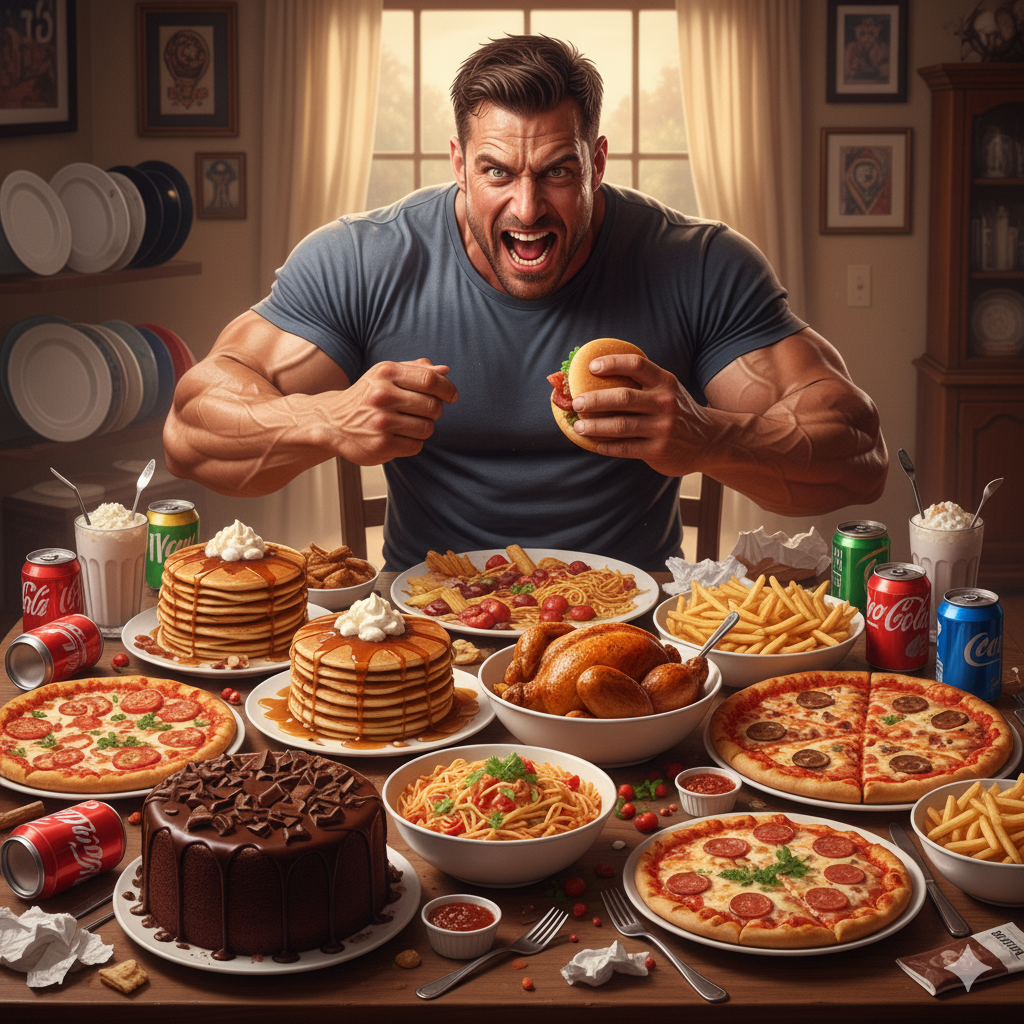
“A cheat day,” the coach went on, “is different. A cheat day is when you throw the plan out the window and pig out on burgers, pizza, donuts, candy—whatever junk you’ve been craving. That’s not a refeed. That’s a binge dressed up in fancy clothes.”
The boy shifted uneasily.
“Refeeds,” said the coach, “can be useful tools. Cheat days? There’s no logical or physiological reason for them at all. They’re romanticized on Instagram, but in reality they’ll do more harm than good.”
Why Refeeds Work
The coach tapped his temple. “There are three main benefits to a refeed. First, energy. Dieting drains you, especially when carbs get low. A refeed tops up glycogen so you can push heavy weights instead of dragging yourself through workouts like a zombie.
“Second, appearance. When glycogen is low, your muscles deflate. They look smaller, even though you’re still carrying the same lean mass. It’s a cruel trick. You look in the mirror and think you’re losing muscle, when really you’re just depleted. A refeed fills you back out. You look better, which keeps you sane.
“Third, metabolism. Restrict calories too long and hormones like leptin start to drop. That makes fat loss slower and cravings worse. A refeed helps keep leptin up, keeps your metabolism humming, and keeps you from turning into a ravenous monster who’d sell his grandmother for a chocolate bar.”
Big Charles laughed. “Sounds like Pete on leg day.”
Skinny Pete blushed and flexed his nonexistent quads.
Why Cheat Days Fail
The boy frowned. “So cheat days aren’t the same thing?”
Coach Thibaudeau snorted. “Not even close. Cheat days are a trap. First, they give you a taste of the foods you’re trying to avoid. That just makes sticking to the plan harder. Second, processed junk isn’t good for you. It doesn’t replenish glycogen better than clean carbs. In fact, it can make you sluggish and ruin your next workout.
“Third, cheat days mess with your head. One cheat turns into two. Two turn into a whole day. And before you know it, you’re telling yourself you’ll ‘start again tomorrow’ while you shovel down enough pizza to feed a football team.”
Skinny Pete piped up timidly. “But Coach, don’t cheat meals make you grow?”
“Grow fat, maybe,” said the coach. “If cheat meals built muscle, half the people at the buffet line would look like bodybuilders.”
Big Charles nearly choked laughing.
Timing the Refeed
The boy looked thoughtful. “So when should I do a refeed?”
“Not right away,” said the coach. “You don’t need one during the first three weeks of your fat loss plan. Your energy will be fine, your muscles won’t be too flat, and your metabolism won’t have slowed yet.
“Dorian Yates—six-time Mr. Olympia—didn’t add refeeds until twenty-one days into his pre-contest diet. If the Shadow could go three weeks without a refeed, so can you.”
The boy nodded slowly.
“After that,” the coach continued, “you use refeeds strategically. Not on a schedule. You add one when your energy tanks, or when cravings get intense. That’s when a clean refeed does its job. It refuels you, it steadies your head, and it keeps you moving forward.”
What Happens if You Cheat Anyway
“Now,” said the coach, “I’m not naive. Cheats might happen. Stress, cravings, life—they sneak up on you. You slip. You eat something off plan. Fine. Don’t panic. Don’t throw the whole day away. Don’t say, ‘Well, I already messed up, might as well eat the whole bakery.’
“You just go right back to your plan on the very next meal. One slip won’t ruin you. Turning one slip into a binge will.”
Big Charles rumbled agreement. “I once ate a whole cheesecake after a bad day. Next morning, I felt like I’d been hit by a truck. Never again.”
Skinny Pete gasped. “A whole cheesecake? That’s like… ten thousand calories!”
“Eleven,” said Big Charles proudly.
The Wrong Question
The coach turned back to his trainee. His voice softened, but his eyes stayed sharp.
“Son, if you ask me about cheat days before you even start, it tells me something. It tells me your head’s not in the right place. You’re looking for loopholes. You’re planning your failures before you’ve even tried.
“That mindset will sink you faster than any slice of pizza. If you’re going to succeed in this fat loss phase, you need to get your head straight. No more thinking about cheat days. Focus on the plan. Trust the process. When you truly need a refeed, I’ll tell you. Until then, stop dreaming about donuts and start dreaming about results.”
The boy’s face reddened. But slowly, he nodded.
“Yes, Coach.”
The Peanut Gallery
Big Charles racked his bar with a crash that made the dumbbells jump. “Coach is right. When I diet, the only thing I cheat on is my alarm clock. And even that don’t end well.”
Skinny Pete set down his dumbbells delicately. “I don’t need refeeds,” he said primly. “I eat clean every day. No fats, no sugar, no salt. Just broccoli and chicken breast.”
Coach Thibaudeau looked at him with pity. “That explains why you haven’t gained a pound in three years, Pete. You’re so scared of fat you might blow away in a stiff breeze.”
Big Charles grinned. “Careful, Pete. Don’t walk past the fan.”
The gym erupted in laughter.
The Final Word
The young trainee tightened his belt and squared his shoulders. He understood now. Cheat days weren’t part of the plan. Refeeds were a tool, not a treat. And his success would depend less on what he ate once in a while and more on what he ate every day.
Coach Thibaudeau clapped him on the back. “Good. Now get to work. The iron doesn’t care about your cravings. The iron only cares about effort.”
And with that, the boy stepped under the bar, no longer thinking about cheat days, but about the work ahead.
A Lesson for Everyone
If you’ve read this far, you’ve probably asked yourself the same question at some point: When’s my cheat day?
The answer is simple. If you’re asking before you start, you’re not ready. Get your head right first.
Use refeeds strategically when you’re flat, tired, or craving so hard you’re ready to chew the furniture. Use clean foods, not junk. Forget the fantasy of cheat days—they’re nothing but roadblocks dressed up as rewards.
And if you do slip? Fine. Own it. Move on. Don’t let one mistake snowball into a weekend binge.
That’s the difference between success and failure in fat loss.
Epilogue: Charles, Pete, and the Boy
Weeks later, the young trainee was leaner than ever. His muscles looked carved, his energy was steady, and his mindset was locked in.
Big Charles, meanwhile, had finished a set of squats so heavy the bar bent like a bow. He wiped the sweat off his face and grinned. “Coach,” he said, “when’s my cheat day?”
Coach Thibaudeau glared at him. “Every day’s your cheat day, Charles. Now go eat your steak.”
Skinny Pete sipped his kale smoothie and sighed. “I just don’t want to get fat.”
The coach rolled his eyes. “Pete, if you ate a whole cheesecake, you’d probably still weigh a buck thirty.”
And the gym rang again with laughter, the clang of iron, and the lesson that cheat days belong in fairy tales, not in real fat loss plans.